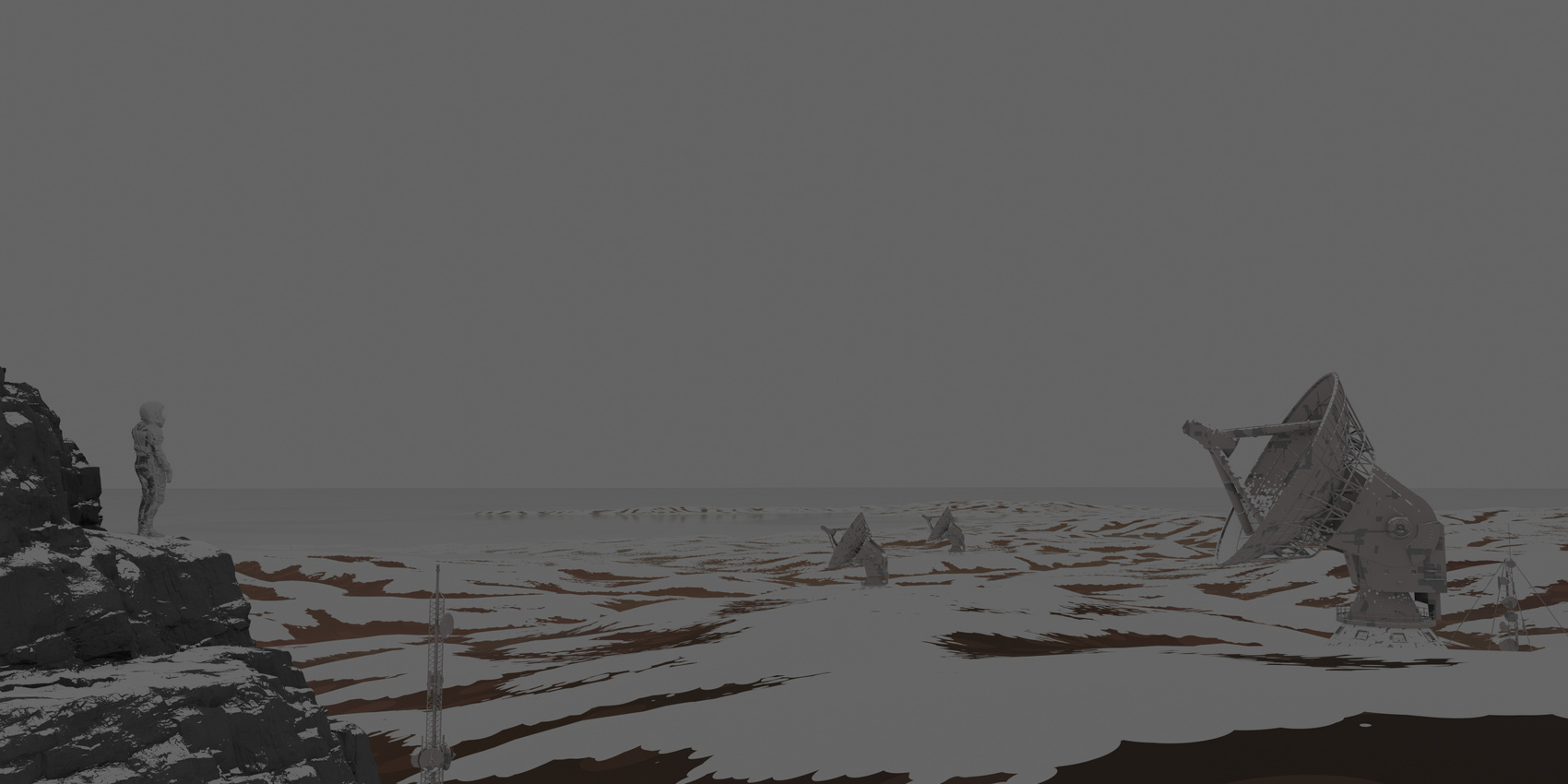































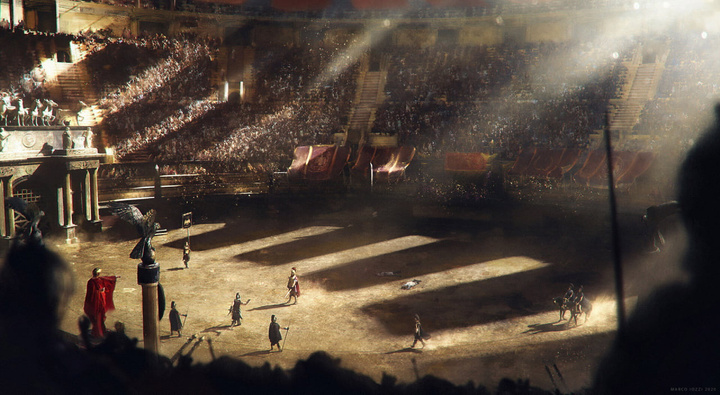





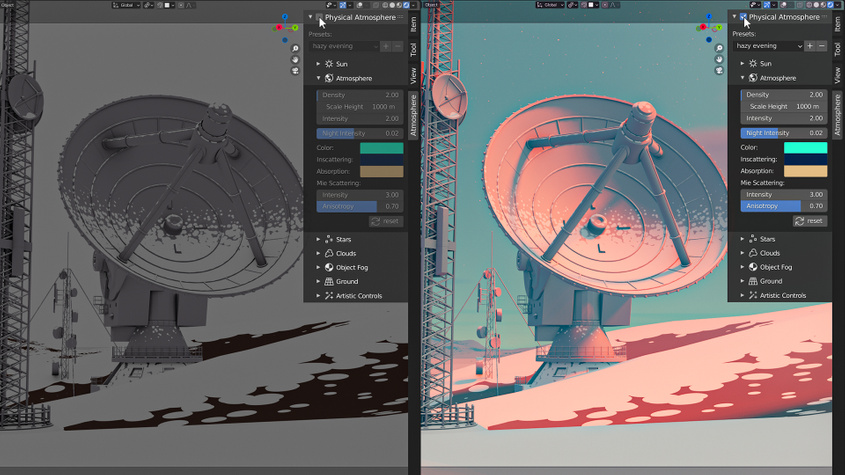
This addon saves hours that usually are invested in manually creating sky, atmosphere and placing sun object and stars, and automates it within a single click.
We have more than a decade of experience with atmosphere rendering techniques in computer graphics industry. Physical Starlight and Atmosphere addon is used in entertainment, film, automotive, aerospace and architectural visualisation industries.

Presets allow to store a snapshot of your customized atmosphere settings and return to it later or use already predefined presets provided by the addon.

We use a procedural method of calculating the atmosphere based on many tweakable parameters, so that sky color is not limited only to the Earth's atmosphere.

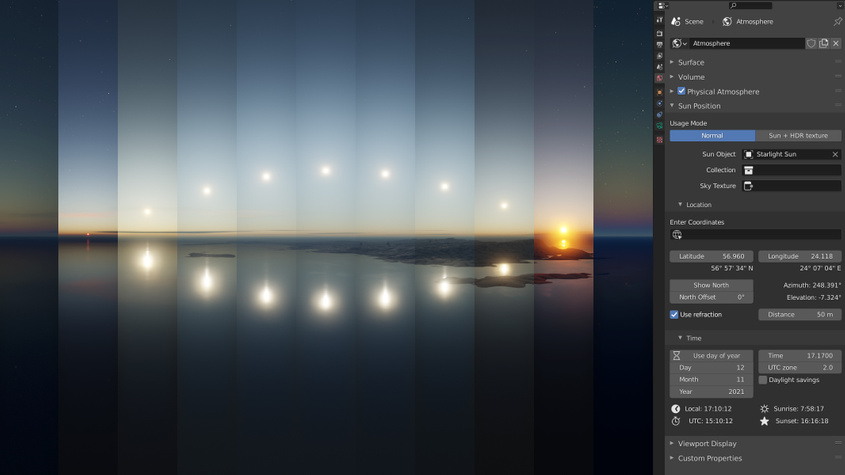
Works well in combination with Blender Sun Position addon. You can simulate any weather at any time.

"Physical Starlight and Atmosphere has been an invaluable tool for me in my personal/professional work and a huge missing link for lighting in Blender. It still feels like magic every time I use it, I can't recommend it highly enough!"

"Physical Starlight and Atmosphere has been an essential add-on for all of my environmental design projects. It gives me such incredibly flexibility and control over the look and feel of my renders. Lighting is key for any project, and this add-on always gives my work that extra edge."

"As a lighting artist, focusing on the overall mood of an image is super important. Physical Starlight and Atmosphere is based on reality, so I can spend all of my time iterating on the look without worrying about how to achieve it. "

"I love the tool. It has been my go-to since I picked it up a couple of months ago."

"My work life has become super easier since I started using Physical Starlight and Atmosphere, it cut down a lot of technical headache associated with setting up a believable lighting condition and gave me more time to concentrate on the creative part of my design process."
If your targeted deployment environment uses custom recovery frameworks (like TWRP or OrangeFox) that skip signature verification, you can zero out the signature metadata block lengths. However, if you are attempting to flash through an official update_engine infrastructure or a locked bootloader using custom keys, you must utilize OpenSSL to generate an RSA private-key signature across the payload.bin metadata space and inject the resulting signature blocks directly into the tail end of the output file. 5. Troubleshooting Common Repack Failures
To understand the "payloadbin exclusive," one must first understand the mechanics of modern console exploitation. In the context of the Nintendo Switch, a "payload" is a piece of code injected into the console’s memory during the boot process, usually via a USB connection or a custom bootloader. These payloads are typically stored in binary files, colloquially referred to as .bin files. They are the delivery trucks of the hacking world, carrying the tools necessary to bypass security measures and run unauthorized software. The term "repack" simply refers to the act of taking an existing file, modifying it, compressing it, or bundling it with new assets, and then re-releasing it as a distinct package.
is a highly specialized, technical procedure used by Android developers, power users, and custom ROM enthusiasts to modify system partition blocks before compiling them back into a flashable Over-The-Air (OTA) update package. Modern Android Original Equipment Manufacturers (OEMs)—such as Google, OnePlus, Xiaomi, and Nothing—use a standardized format called payload.bin to pack system firmware image files into a single block-based compression container.
The terms , payload.bin , and exclusive refer to the high-stakes world of Android firmware modification and digital "jailbreaking." Specifically, a payload.bin is a compressed package containing the core "soul" of a phone's operating system (boot, system, and vendor images).
This exclusive technical guide covers everything you need to know about the block-based structure of Android OTA updates, the tools required to repack them, and how to flash your custom payloads safely. Understanding the Payload.bin Architecture repack payloadbin exclusive
The process begins with the original software or data asset. Analysts deconstruct the archive to identify core files versus optional files. For an exclusive repack, non-essential data (such as extraneous debug logs or redundant assets) is stripped away to minimize the baseline footprint. 2. Custom Optimization and Scripting
update_metadata_pb2.py (The compiled Python class generated by protoc ). 3. The Structural Mechanics of a Payload File
: Permanently removing carrier tracking software or unwanted apps at the system level. Technical Prerequisites
But what does it actually mean? Is it a tool, a technique, or a service? For security professionals and ethical hackers, understanding this phrase is critical to defending modern networks. For the curious, it is a window into how malware is customized to evade detection. If your targeted deployment environment uses custom recovery
Mounting a raw system.img block file as a read/write loop device under Linux to inject private enterprise utilities, custom system configurations, or debloat applications. Step 3: Compiling the Protobuf Manifest
This public link is valid for 7 days and shares a thread, including any personal information you added. This link or copies made by others cannot be deleted. If you share with third parties, their policies apply. Can’t copy the link right now. Try again later.
For enthusiasts operating within resource constraints, this distribution method offers several distinct advantages over standard retail files.
If you need help setting up a deployment pipeline or want to learn more about specific compression frameworks, tell me: They are the delivery trucks of the hacking
Only download exclusive repacks from trusted sources. Scam or malicious payloads can damage your device. Trusted forums like GBAtemp or well-known, reputable developer GitHub pages are the best places to look.
Recent research has explored using protected binaries. One article on building a "last-resort unpacker with AI" notes that "malicious software is often designed to hide its true behavior, wrapping its underlying logic in layers that make it difficult to analyze". The idea is that AI could help automate the recovery of payloads from unknown or custom packers, a task that is currently a major bottleneck in malware analysis.
Understanding the difference between software-based injectors (like TegraRcmGUI) and hardware-based dongles (like the RCMloader) is essential for selecting a reliable method for code execution.